About 222 minutes
Unveiling a Parallel: A Romance — Reading Notes
Space Future
51,053 recorded words. 11 minutes difference from this book's estimate.
View Gutenberg source #42816
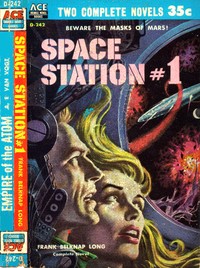
The source record for Space Station 1 — Text and Context measures this digital text at 53,561 words, 3 hr 53 min estimated reading time, and 5 detected text sections.
The text analysis averages about 14.4 words per sentence, while the detected sections provide another way to judge how the source is divided.
Project Gutenberg metadata also associates the work with “Science fiction,” connecting these edition facts with the source record’s subject description.
Explore this collection
These alternatives are selected using recorded categories and estimated reading time.
About 222 minutes
Space Future
51,053 recorded words. 11 minutes difference from this book's estimate.
View Gutenberg source #42816About 165 minutes
Space Future
37,763 recorded words. 68 minutes difference from this book's estimate.
View Gutenberg source #29448About 93 minutes
Space Future
21,296 recorded words. 140 minutes difference from this book's estimate.
View Gutenberg source #30815Search stored excerpts and compare books → Choose by your preferences →
Choices use stored catalog measurements. Estimates vary with reading speed. A shared category is a catalog label, not a claim that two books have the same argument or literary quality.
Search reads excerpt text stored with this catalog and links to its associated Gutenberg record. The connection is stored in the site database; this tool does not recheck that every excerpt is word-for-word identical to that external record. Excerpt search does not cover every chapter and does not verify historical publication dates.
Catalog snapshot checked: 2026-09-25. Coverage: 100 public books, 100 available source excerpts.
Read the complete public-domain text at its original source.
Read on Project GutenbergThe novel opens with a life-and-death struggle in total darkness: Lieutenant Corriston, unarmed, dodges a knife-wielding killer in a confined space. The prose emphasizes physical sensation—the swish of heels, the chill of a steel girder, the ache in his groin—creating a claustrophobic, visceral tension. This immediate plunge into violence sets the tone for a story where danger is intimate and personal.
Yet the narrative soon shifts to a very different kind of confinement: Helen Ramsey describes her father's cold control, her isolation from young men, and her desperate bid for freedom by donning a mask from the Gresham-Ramsey Laboratories. The contrast between Corriston's physical fight and Helen's social imprisonment suggests that the space station itself may be a stage for multiple forms of entrapment.
The opening scene is remarkable for its sensory focus. Corriston is in total darkness, relying on sound and touch: he hears the killer's heels pivot, feels the girder's cold surface, and judges the next blow by instinct. The knife is not seen but felt—slashing, then retreating. Long builds tension through physical details: the cut on Corriston's shoulder, the throbbing at his temples, the heart's furious pounding. The setting is a confined space, probably part of the space station, but it could be any dark enclosure. This anonymity makes the threat universal: the killer is described only as lithe, muscular, and cunning, with no name or motive given. The struggle is purely about survival, stripped of context. The prose is lean, avoiding exposition, and the reader is left as blind as Corriston.
Helen Ramsey's monologue reveals a different kind of confinement. She describes her father as cold, like the slabs in the family mausoleum, and her life as one of enforced isolation: no dances, no moonlight walks, no young men. Her father's wealth is a cage, and the bodyguards are its bars. The mask she uses to escape is a product of her father's own laboratories—a detail that suggests the tools of control can be turned to liberation. The mask is not just a disguise; it is a symbol of the identity she wants to shed. Her speech is emotional, punctuated by the repeated word 'darling,' and she confesses a desire to be 'somebody else and be completely free.' The contrast with Corriston's physical fight is stark: her struggle is psychological, fought with words and a plastic mask.
The excerpts juxtapose two forms of conflict: Corriston's immediate, physical fight for his life, and Helen's long-term, social fight for autonomy. Both are set against the backdrop of the space station, described in the book's blurb as a place of 'unsuspected terrors' where impostors and monsters lurk. But the terrors here are human: a killer with a knife, a father with a fortune. The station itself is a liminal space—between Earth and Mars, between freedom and control. Helen's journey to Mars is meant to be a step toward independence, but she is pursued by her father's agents. Corriston, meanwhile, is drawn into a mystery he did not seek. The excerpts do not reveal how these threads connect, but they suggest that the station is a crucible where personal and cosmic stakes collide.
Readers should attend to how Long uses physical detail to convey psychological states. The darkness of the opening fight is not just a setting but a metaphor for the unknown threats that pervade the station. Helen's mask, similarly, is a literal object that carries symbolic weight. The novel's tension lies in the interplay between these concrete, sensory elements and the larger questions of identity and freedom they evoke. The excerpts offer only a glimpse, but they reward close attention to the craft of suspense.
That knife in the dark — I remember reading this on a gray afternoon, how the confined violence made Mars feel like a deep breath. It brought back a similar ache from The Snare — Context and Discussion, where a different kind of trap waits in quiet domesticity. Long’s heiress and that novel’s prisoner both felt the walls closing, and I sat there just letting that weight settle. Strange how two old books can share one lonely pulse.
Save your reaction, strongest insight, and memorable passage.