About 71 minutes
The Test Colony — Themes and Context
Space Future
16,155 recorded words. 3 minutes difference from this book's estimate.
View Gutenberg source #32676
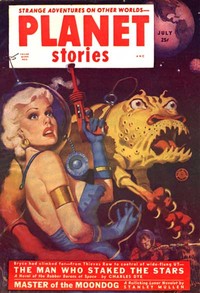
This digital edition of Master of the Moondog — Text and Context is described by source-level measurements including 15,515 words, 1 hr 8 min estimated reading time, and 2 detected text sections.
The text analysis averages about 11.3 words per sentence, while the detected sections provide another way to judge how the source is divided.
Project Gutenberg metadata also associates the work with “Science fiction,” connecting these edition facts with the source record’s subject description.
Explore this collection
These alternatives are selected using recorded categories and estimated reading time.
About 71 minutes
Space Future
16,155 recorded words. 3 minutes difference from this book's estimate.
View Gutenberg source #32676About 72 minutes
Space Future
16,507 recorded words. 4 minutes difference from this book's estimate.
View Gutenberg source #31897About 55 minutes
Space Future
12,650 recorded words. 13 minutes difference from this book's estimate.
View Gutenberg source #31664Search stored excerpts and compare books → Choose by your preferences →
Choices use stored catalog measurements. Estimates vary with reading speed. A shared category is a catalog label, not a claim that two books have the same argument or literary quality.
Search reads excerpt text stored with this catalog and links to its associated Gutenberg record. The connection is stored in the site database; this tool does not recheck that every excerpt is word-for-word identical to that external record. Excerpt search does not cover every chapter and does not verify historical publication dates.
Catalog snapshot checked: 2026-09-25. Coverage: 100 public books, 100 available source excerpts.
Read the complete public-domain text at its original source.
Read on Project GutenbergThe story opens with a memorable description of Charley, a moondog that looks like "an oversized comma of something vague and luminous" with a "fat yellow balloon" head and a tapering body. Mullen establishes the creature's electronic nature early: Charley can cling to metal, propel himself, and short-circuit equipment—as he does by burning out a transformer, landing both him and his owner Tod Denver in a "mutual doghouse." The opening paragraph also sets the tone with a wry comparison: "Temperature outside was a rough 280 degrees F., which is plenty rough and about three degrees cooler than Hell."
Charley is not merely a comic sidekick; the creature's behavior and Denver's reactions to it establish character and conflict. Denver won Charley in a crap game and has tried repeatedly to sell or trade him, but Charley always returns—"Charley liked Denver too well to put up with less interesting owners." The relationship is one of exasperated affection: Denver is "fond of Charley, as one might be of an idiot child." This dynamic recurs throughout the excerpts, with Charley causing mechanical failures and Denver responding with mock songs like "Mad dogs and Martians go out in the Lunar sun." The pet's magnetic personality and physiology mirror Denver's own stubbornness and resourcefulness.
When a ship appears "painted a quick-dying trail of fire upon the black vault of sky," Denver must decide between fighting or fleeing. The excerpts show him choosing flight, motivated by the presence of a woman named Darbor: "he had desperate, painful desire to live for her." The chase becomes a "nerve-wracking game of hare and hounds" across "tricky floods of Earthlight" and "slopes and spills of broken rock." Mullen emphasizes the harsh environment: the fugitives must navigate by shadow-apex calculations, guessing whether the light source is the sun or Earth. The tension is heightened by the need to locate an old Martian working before the pursuers close in.
The old Martian mine represents both a refuge and a potential source of wealth. Denver follows "deep-cut arrow markings" that lead to the site, but the directions are imprecise—"Laird Martin had expected his directions to be gone into under less harrowing circumstances." The search involves calculating the "shadow-apex of Mitre Peak at 2017 ET," a detail that grounds the story in a specific, technical challenge. Once the markings are found, the race becomes a grim sprint to reach the mine and set up defenses. The stakes are explicit: "Life, or a fighting chance to defend life, possible wealth from the ancient workings, made a glittering goal ahead."
Mullen's prose mixes hard-boiled dialogue with vivid, sometimes playful description. The opening line—"It was Charley's fault, of course; all of it..."—sets a wry, confessional tone. The narrative moves between action and reflection, with short, punchy sentences during chase scenes: "He chose flight." The excerpts also reveal a tendency toward simile and metaphor: the moondog "looked like an oversized comma," and the ship's landing flares are "short-lived rocket landing flares." The structure alternates between Denver's internal calculations and external threats, creating a rhythm of problem-solving and sudden danger. These stylistic choices give the story a distinctive voice that balances humor with suspense.
Readers should pay attention to how Mullen uses Charley not just for comic relief but as a plot device that creates mechanical problems and solutions. The moondog's electronic nature may prove crucial in later scenes. Likewise, the technical details about Lunar navigation and mining are not mere decoration—they drive the plot forward. The excerpts leave the outcome uncertain, but the careful setup of Denver's character and the mine's location suggests a payoff that rewards close reading of the early clues.
There’s something about Tod Denver and that odd little moondog that stays with you, not the chase itself but the quiet gravity of a creature choosing its human. It reminds me of how I felt reading Jaywalker — Inside the Classic, that same tender pull between strangeness and loyalty. Jaywalker — Inside the Classic earned a place beside it on my shelf, a small comfort I return to on slow evenings.
Build a private reading journal entry for this title.