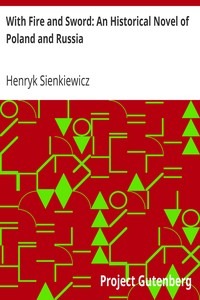
With Fire and Sword: An Historical Novel of Poland and Russia by Henryk Sienkiewicz

(14 User reviews)   7211
By John White Posted on Dec 22, 2025
In Category - Aviation
Sienkiewicz, Henryk, 1846-1916 Sienkiewicz, Henryk, 1846-1916
English
Hey, have you ever wondered what Game of Thrones would look like if it were based on real history? That's this book. It's 1647, and the Polish-Lithuanian Commonwealth is about to explode. We follow a cast of unforgettable characters—a brave knight, a fierce Cossack leader, and a woman caught between them—as a massive Cossack uprising tears the region apart. This isn't just a war story; it's about loyalty, love, and survival when your entire world is on fire. The action is huge, but the personal stories will keep you up at night. Trust me, you'll be Googling this period halfway through.
Share

Read "With Fire and Sword: An Historical Novel of Poland and Russia by Henryk Sienkiewicz" Online

This book is available in the public domain. Start reading the digital edition below.

START READING FULL BOOK
Instant Access    Mobile Friendly

Book Preview

A short preview of the book’s content is shown below to give you an idea of its style and themes.

was accompanied by the missionary, followed by the political colonist. The people of the country deprived of their lands were reduced to slavery; and if any escaped this lot, they were men from the higher classes who joined the conqueror in the capacity of assistant oppressors. The work was long and doubtful. The Germans made many failures, for their management was often very bad. The Slavs west of the Oder were stubborn, and under good leadership might have been invincible; but the leadership did not come, and to the Germans at last came the Hohenzollerns. For the serious student there is no richer field of labor than the history of Poland and the Slavs of the Baltic, which is inseparable from the history of Mark Brandenburg and the two military orders, the Teutonic Knights and the Knights of the Sword. The conquest of Russia by the Mongols, the subjection of Europeans to Asiatics,--not Asiatics of the south, but warriors from cold regions led by men of genius; for such were Genghis Khan, Tamerlane, and the lieutenants sent to the west,--was an affair of incomparably greater magnitude than the German wars on the Baltic. The physical grip of the Mongol on Russia was irresistible. There was nothing for the Russian princes to do but submit if they wished to preserve their people from dissolution. They had to bow down to every whim of the conqueror; suffer indignity, insult, death,--that is, death of individuals. The Russians endured for a long time without apparent result. But they were studying their conquerors, mastering their policy; and they mastered it so well that finally the Prince of Moscow made use of the Mongols to complete the union of eastern Russia and reduce all the provincial princes of the country, his own relatives, to the position of ordinary landholders subject to himself. The difference between the Poles and Russians seems to be this,--that the Russians saw through the policy of their enemies, and then overcame them; while the Poles either did not understand the Germans, or if they did, did not overcome them, though they had the power. This Slav history is interesting to the man of science, it is interesting also to the practical statesman, because there is no country in the Eastern hemisphere whose future may be considered outside of Russian influence, no country whose weal or woe may not become connected in some way with Russia. At the same time there are no states studied by so few and misunderstood by so many as the former Commonwealth of Poland,--whose people, brave and brilliant but politically unsuccessful, have received more sympathy than any other within the circle of civilization,--and Russia, whose people in strength of character and intellectual gifts are certainly among the first of the Aryan race, though many men have felt free to describe them in terms exceptionally harsh and frequently unjust. The leading elements of this history on its western side are Poland, the Catholic Church, Germany; on the eastern side they are Russia, Eastern Orthodoxy, Northern Asia. Now let us see what this western history was. In the middle of the ninth century Slav tribes of various denominations occupied the entire Baltic coast west of the Vistula; a line drawn from Lubeck to the Elbe, ascending the river to Magdeburg, thence to the western ridge of the Bohemian mountains, and passing on in a somewhat irregular course, leaving Carinthia and Styria on the east, gives the boundary between the Germans and the Slavs at that period. Very nearly in the centre of the territory north of Bohemia and the Carpathians...

This is a limited preview. Download the book to read the full content.

The Story

It’s the mid-1600s, and the vast Polish-Lithuanian Commonwealth is a powder keg. On one side are the Polish nobility and their armies. On the other are the Cossacks of Ukraine, led by the formidable Bohdan Khmelnytsky, who feel oppressed and are ready to fight for freedom. The story throws us right into the middle of this. We follow Jan Skrzetuski, a loyal Polish soldier, and his friend, the boastful but good-hearted nobleman Zagłoba. Their lives are turned upside down by war and by love, as Skrzetuski is separated from his beloved Helena, who is caught in the deadly crossfire.

The book is a sweeping ride through massive battles, daring escapes, and political schemes. It shows the war from all angles, making you understand—and sometimes even sympathize with—both sides of the conflict.

Why You Should Read It

Forget dry history lessons. Sienkiewicz makes this era feel alive and urgent. Yes, the battles are epic, but what got me were the characters. They’re flawed, funny, and incredibly brave. Zagłoba, in particular, is a scene-stealer—a coward who finds his courage in the wildest ways. The book asks tough questions about honor, national identity, and what we’re willing to sacrifice. It doesn’t shy away from the brutality of war, but it’s balanced by deep friendships and a love story that actually matters to the plot.

Final Verdict

This is a classic for a reason. It’s perfect for anyone who loves big, meaty historical fiction with heart and grit. If you enjoyed books like Pillars of the Earth or movies with grand, old-fashioned adventure, you’ll feel right at home. Be prepared for a long, immersive read—it’s the first in a trilogy—but you’ll be rewarded with a story that sticks with you long after the last page.


📢 No Rights Reserved

This is a copyright-free edition. Use this text in your own projects freely.

Brian Wright
1 year ago

This is one of those stories where the depth of research presented here is truly commendable. Highly recommended.

Elizabeth Scott
1 year ago

Very interesting perspective.

Jennifer Scott
1 year ago

If you enjoy this genre, the flow of the text seems very fluid. I learned so much from this.

Nancy Thompson
7 months ago

Read this on my tablet, looks great.

Mary Brown
1 year ago

Enjoyed every page.

4.5
4.5 out of 5 (14 User reviews )

Add a Review

Your Rating *
There are no comments for this eBook.
You must log in to post a comment.
Log in


Related eBooks