About 73 minutes
The Serpent River — Text and Context
Other Worlds
16,770 recorded words. 3 minutes difference from this book's estimate.
View Gutenberg source #50923
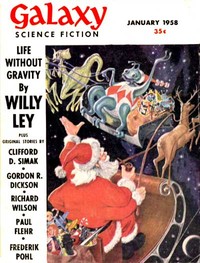
For The World That Couldn't Be — Edition Insights, the stored edition analysis reports 17,473 words, 1 hr 16 min estimated reading time, and 3 detected text sections.
The text analysis averages about 14.1 words per sentence, while the detected sections provide another way to judge how the source is divided.
Project Gutenberg metadata also associates the work with “Science fiction,” connecting these edition facts with the source record’s subject description.
Explore this collection
These alternatives are selected using recorded categories and estimated reading time.
About 73 minutes
Other Worlds
16,770 recorded words. 3 minutes difference from this book's estimate.
View Gutenberg source #50923About 65 minutes
Other Worlds
14,908 recorded words. 11 minutes difference from this book's estimate.
View Gutenberg source #32054About 54 minutes
Other Worlds
12,394 recorded words. 22 minutes difference from this book's estimate.
View Gutenberg source #51297Search stored excerpts and compare books → Choose by your preferences →
Choices use stored catalog measurements. Estimates vary with reading speed. A shared category is a catalog label, not a claim that two books have the same argument or literary quality.
Search reads excerpt text stored with this catalog and links to its associated Gutenberg record. The connection is stored in the site database; this tool does not recheck that every excerpt is word-for-word identical to that external record. Excerpt search does not cover every chapter and does not verify historical publication dates.
Catalog snapshot checked: 2026-09-25. Coverage: 100 public books, 100 available source excerpts.
Read the complete public-domain text at its original source.
Read on Project GutenbergClifford D. Simak's The World That Couldn't Be opens with a farmer's pragmatic grievance: a Cytha has been methodically shearing vua plants, and Gavin Duncan resolves to hunt it despite warnings from his native foreman, Zikkara. The story's structure alternates between Duncan's relentless pursuit and the Cytha's increasingly desperate adaptations—from a simple beast to a talking, negotiating entity. Simak builds tension through recurring images of the bush: sun-cured grass, thorn-choked ravines, and the ever-present dust. The narrative moves from the cultivated field into the wild, then back to campfire confrontations, each shift raising the stakes of the hunt.
Duncan's motivation is economic: the Cytha threatens his crop, and without a harvest he must leave the planet. Simak grounds this in concrete detail—the beast shears off plants an inch or two above ground, working methodically down ten rows. Duncan's reasoning is blunt: "I hunt anything that damages my crop." The native Zikkara counters with cultural prohibition: "No one hunts the Cytha." This clash of worldviews is not abstract; it plays out in the negotiation over survival. Duncan reminds Zikkara of the benefits of settled farming—regular meals, medical care—but Zikkara's fear persists. The farmer's logic is utilitarian, but the story questions whether that logic can hold against a creature that learns and communicates.
The Cytha's defining trait is its ability to adapt. Duncan theorizes "progressive adaptation" that could lead to communication, but the Cytha's adaptations are also defensive: it tries an arrow, a rockslide, and even enlists Sipar's loyalty. Simak presents adaptation as a kind of arms race. The Cytha speaks to Duncan, proposing a future hunt as a game: "When I am ready to be hunted, I shall come and tell you." This offer unsettles Duncan, who responds with a burst of gunfire. The narrative lingers on the aftermath—Duncan's trembling hands, the five bloody chunks of flesh he cannot reassemble. Adaptation, the story suggests, may be running down; the Cytha's parley hints at desperation.
Simak's setting is not a backdrop but an active participant. The bush is described with precise sensory details: the whir of a sawmill bird, the click of chatterers, the glare of sun on hula-tree leaves "like a million flashing mirrors." The terrain is treacherous—ravines, waterholes, thorn scrub—and Duncan must navigate it while tracking the Cytha. The landscape mirrors the psychological tension: the "fear that had been stalking him" walks out from the shadows to hunker by the campfire. The physical environment and the hunter's internal state converge, making every step of the chase a confrontation with the unknown.
The hunt in The World That Couldn't Be is not a simple contest of predator and prey. Duncan kills the Cytha "inch by inch," carving off pieces over multiple encounters. The Cytha, in turn, attempts to negotiate, offering a reciprocal hunt. This reciprocity challenges Duncan's assumption of dominance. The native Sipar's loyalty to the Cytha—and his subsequent suicide—suggests a moral order that Duncan cannot grasp. Simak leaves the reader with an uneasy question: what does it mean to hunt a creature that can talk, adapt, and perhaps forgive? The story does not resolve this; it only shows Duncan reloading his rifle, the fear still present.
Simak uses a tight third-person perspective, largely limited to Duncan's thoughts and observations. The reader sees the Cytha only through Duncan's eyes—as a threat, a puzzle, a speaking adversary. This limited viewpoint heightens the mystery: we never learn the Cytha's true nature or motives. The dialogue between Duncan and Zikkara reveals cultural friction, but the narrative never fully endorses either side. The prose is lean, with short sentences that accelerate during action sequences: "He held the trigger down and the gun danced in insane fury." The effect is immersive, placing the reader in the hunter's skin without offering easy answers.
Readers approaching The World That Couldn't Be should attend to the way Simak builds tension through incremental revelations—each encounter with the Cytha adds a layer of complexity. The novella rewards attention to its environmental details, which are never merely decorative. Consider how the hunt structure mirrors the theme of adaptation: both hunter and prey are transformed by the chase. The story leaves its central question open, inviting reflection on what constitutes a justifiable kill when the quarry can talk back.
That farmer chasing the shifting Cytha stayed with me—how every attempt to pin down what he faced only changed it. It made me think of that quiet ache in The Hero — Context and Discussion, where understanding something means letting it stay partly unknown. Both left me sitting still afterward, not wanting to turn the page too fast.
Save your reaction, strongest insight, and memorable passage.