About 48 minutes
A Stone and a Spear — A Reader’s Guide
Social Speculation
10,859 recorded words. 0 minutes difference from this book's estimate.
View Gutenberg source #51075
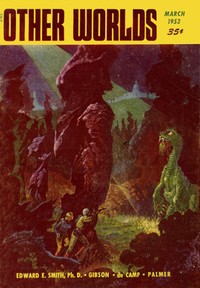
This digital edition of Tedric — Story, Setting & Ideas is described by source-level measurements including 10,849 words, 48 min estimated reading time, and 2 detected text sections.
The text analysis averages about 15.9 words per sentence, while the detected sections provide another way to judge how the source is divided.
Project Gutenberg metadata also associates the work with “Science fiction,” connecting these edition facts with the source record’s subject description.
Explore this collection
These alternatives are selected using recorded categories and estimated reading time.
About 48 minutes
Social Speculation
10,859 recorded words. 0 minutes difference from this book's estimate.
View Gutenberg source #51075About 51 minutes
Social Speculation
11,712 recorded words. 3 minutes difference from this book's estimate.
View Gutenberg source #29727About 51 minutes
Social Speculation
11,623 recorded words. 3 minutes difference from this book's estimate.
View Gutenberg source #51201Search stored excerpts and compare books → Choose by your preferences →
Choices use stored catalog measurements. Estimates vary with reading speed. A shared category is a catalog label, not a claim that two books have the same argument or literary quality.
Search reads excerpt text stored with this catalog and links to its associated Gutenberg record. The connection is stored in the site database; this tool does not recheck that every excerpt is word-for-word identical to that external record. Excerpt search does not cover every chapter and does not verify historical publication dates.
Catalog snapshot checked: 2026-09-25. Coverage: 100 public books, 100 available source excerpts.
Read the complete public-domain text at its original source.
Read on Project GutenbergThe story opens not with its title character, but with a tense debate between Prime Physicist Skandos and his assistant Furmin, who are observing a critical point in human history through a "chronoviagram." Their discussion establishes a central tension: the desire to intervene in the past versus the fear of catastrophic consequences. Skandos argues that allowing Tedric, a blacksmith in the ancient land of Lomarr, to die without realizing his potential is a tragedy, while Furmin warns that even a minor interference could snap their entire time-track out of existence. This framing device sets up a narrative that oscillates between futuristic speculation and swashbuckling adventure.
Tedric is introduced not through description but through action: he awakens to a voice commanding him to rise, and immediately we are thrust into a world where gods are tangible and killable. The text reveals that Tedric has already killed one manifestation of the god Sarpedion—ripping out his liver—when the king arrives to report that priests have taken Princess Rhoann for sacrifice to another version of the same god. Tedric's response is immediate and visceral: "With a blistering oath he dropped the god's liver, whirled around and leaped down the stairway." This moment encapsulates the story's blend of the mundane and the mythic, where a blacksmith treats divine organs as casually as offal.
A key plot device is Tedric's armor, described as "not of iron, but of god-metal, the metal of Llosir." This armor serves both as a literal protection and as a psychological weapon. When Tedric commands a soldier to strike him with full force, the soldier's sword shatters on impact, visibly shocking both the Royal Guard and the enemy. The scene is a masterclass in building morale through demonstration: Tedric uses the armor to prove that his god, Llosir, is superior to Sarpedion, thereby rallying the troops. The armor also hints at the intervention of Skandos and Furmin, who may have provided it, though the text leaves this connection implicit.
The framing narrative of Skandos and Furmin is not merely a prologue; it infuses the entire story with a sense of urgency. Skandos's line, "The critical point in time of mankind's whole existence is there—RIGHT THERE!" establishes that Tedric's actions have cosmic stakes. The physicists' debate about the ethics of interference—"which is better, to have our entire time-track snapped painlessly out of existence... or to sit helplessly... while we watch civilization build up to its own total destruction?"—echoes through the adventure. This dual timeline structure creates a tension between the immediate, visceral combat and the abstract, theoretical consequences of changing history.
Readers should pay attention to how Smith balances the two narrative threads: the futuristic debate about time and the ancient-world swordplay. The story's brevity (under 11,000 words) means every scene serves double duty, advancing both the plot and the thematic conflict between action and consequence. The illustrations by J. Allen St. John, mentioned in the catalog, likely complement the vivid imagery of the text, particularly the armor and the temple battle.
That old Smith tale stayed with me strangely — the blacksmith’s hammer against a god’s whim, yet the real power hiding in a future mind tugging history’s strings. It made me think of Nor Iron Bars a Cage.... — Themes and Context, and how both quietly wonder if freedom is ever truly ours, or just borrowed. I keep turning that over at night.
Build a private reading journal entry for this title.