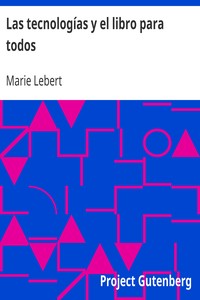
Las tecnologías y el libro para todos by Marie Lebert

(18 User reviews)   5738
By John White Posted on Jan 3, 2026
In Category - Aviation
Lebert, Marie Lebert, Marie
Spanish
Hey, have you ever wondered how we went from heavy, expensive books to carrying entire libraries in our pockets? This book answers that question in the most fascinating way. It's not a dry tech manual—it's the story of how regular people fought to make knowledge available to everyone. The author shows how activists, librarians, and volunteers around the world used new tools to break down barriers. If you love books and believe everyone should have access to them, you'll find this story both inspiring and surprisingly personal. It connects the dots between the early internet and the e-reader in your bag.
Share

Read "Las tecnologías y el libro para todos by Marie Lebert" Online

This book is available in the public domain. Start reading the digital edition below.

START READING FULL BOOK
Instant Access    Mobile Friendly

Book Preview

A short preview of the book’s content is shown below to give you an idea of its style and themes.

acceso - es decir accesible desde cualquier navegadora y en cualquier momento. Gracias al Proyecto Gutenberg, al Internet Archive y a otros proyectos, el sueño empieza a hacerse realidad, al menos para los libros del dominio público. Este proceso empezó hace tiempo gracias a los esfuerzos de algunos precursores. El "libro para todos" nació con el Proyecto Gutenberg, creado por Michael Hart en julio de 1971. El objetivo era utilizar las "nuevas tecnologías" para difundir gratuitamente bajo forma electrónica las obras literarias que pertenecían al dominio público. Ahora funciona a toda marcha. Aunque de momento se encuentren con dificultades a la hora de digitalizar libros con copyright, muchas instituciones se interesan por ver los problemas de copyright solucionados, para ofrecer libre acceso a cuantos libros sea posible. Otra cuestión importante es la relectura de los libros digitalizados, que garantiza una precisión mayor del texto sin ninguna pérdida respecto a la versión impresa. Los programas OCR de buena calidad deberían garantizar una precisión al 99%, dejando unos diez errores por página. Aunque el Proyecto Gutenberg recalca la importancia de esta etapa, no es el caso del Internet Archive, de Google y de muchos otros, que casi prescinden de esta etapa. Con métodos diversos, todos trabajan para alcanzar el mismo sueño de una biblioteca digital universal. 25 millones de libros (sin contar las diversas versiones del mismo libro) pertenecen al dominio público. A mediados de 2007, más de 2 millones tenían libre acceso en la red. CRONOLOGÍA 1968: El ASCII es el primer sistema de codificación para computadores. 1971: El Proyecto Gutenberg es la primera biblioteca digital en el mundo. 1974: Se crea el internet. 1990: Se crea la World Wide Web como una red mundial en el internet. 1991: El Unicode es un sistema de codificación que permite tratar todos los idiomas del planeta. 1993: La Online Books Page es un catálogo de libros gratuitos en la web. 1993: Adobe crea el formato PDF, así como el Acrobat Reader, su programa de lectura. 1994: Se funda el Consorcio W3 para desarrollar los protocolos comunes de la web. 1995: Amazon.com empieza como gran librería en línea. 1996: Se funda el Internet Archive para archivar la totalidad de la web. 1996: El Palm Pilot es el primer asistente personal (PDA). 1999: El Open eBook (OeB) propone un formato estándar para el libro digital. 1999: Dos bibliotecarios digitales cuentan sus experiencias. 1999: La web se hace multilingüe, con cada vez más páginas en otros idiomas que el inglés. 2000: Mobipocket se especializa en libros digitales para asistentes personales. 2000: La Public Library of Science (PLoS) propone lanzar periódicos científicos y médicos en línea. 2000: Distributed Proofreaders ayuda a la digitalización de los libros del dominio público. 2000: La British Library pone en línea la versión digital de la Biblia de Gutenberg. 2001: Wikipedia es una gran enciclopedia de elaboración colectiva en línea. 2003: El MIT OpenCourseWare es un conjunto gratuito de clases del Massachusetts Institute of Technology. 2004: El Proyecto Gutenberg se hace internacional y lanza el Proyecto Gutenberg Europa. 2005: Google Print / Google Book Search es el proyecto de biblioteca digital mundial de Google. 2005: El Open Content Alliance (OCA) es un proyecto cooperativo para una biblioteca digital mundial pública. 2006: Live Search Books es el proyecto de biblioteca digital mundial de Microsoft. 2006: El gran catálogo conjunto WorldCat de OCLC está disponible gratuitamente. 2007: Citizendium es una enciclopedia colectiva y académica en línea. 2007: La Encyclopedia of Life es una enciclopedia colectiva de ciencias de la vida. 1968: ASCII El código ASCII (American Standard Code for Information Interchange) fue creado como...

This is a limited preview. Download the book to read the full content.

Marie Lebert's book isn't about gadgets; it's about a movement. It chronicles the decades-long push to make books and knowledge truly accessible using digital tools.

The Story

The book starts in the late 20th century, when computers were new and the internet was just for universities. It follows a global network of pioneers—librarians, volunteers, and tech enthusiasts—who saw a problem: books were locked away by cost, geography, or physical limitations. The story shows their step-by-step work, from typing out classic texts by hand to create the first free digital libraries, to developing early e-book formats and fighting for legal changes. It's a clear, human-centered look at how the pieces of our digital reading world were put together.

Why You Should Read It

This book changed how I see my e-reader. It’s easy to take instant access for granted. Lebert makes you appreciate the fight behind that convenience. She highlights unsung heroes and shows that this wasn't an inevitable corporate project, but a conscious effort driven by a belief in sharing. It’s a hopeful reminder that technology, when guided by the right values, can be a powerful force for equality.

Final Verdict

Perfect for curious readers who enjoy history, technology, or social change. If you've ever downloaded a free classic from Project Gutenberg or wondered how we got here, this is your backstage pass. It’s a straightforward, inspiring account of the people who built the foundation for the book-filled world we live in today.


📚 License Information

This content is free to share and distribute. Distribute this work to help spread literacy.

Ashley Lee
6 months ago

I didn't expect much, but it creates a vivid world that you simply do not want to leave. A true masterpiece.

Michelle Torres
1 year ago

The index links actually work, which is rare!

Steven Allen
1 year ago

Helped me clear up some confusion on the topic.

Elijah Johnson
8 months ago

Solid story.

Elizabeth Ramirez
1 year ago

Without a doubt, the content flows smoothly from one chapter to the next. One of the best books I've read this year.
4.5
4.5 out of 5 (18 User reviews )

Add a Review

Your Rating *
There are no comments for this eBook.
You must log in to post a comment.
Log in


Related eBooks