
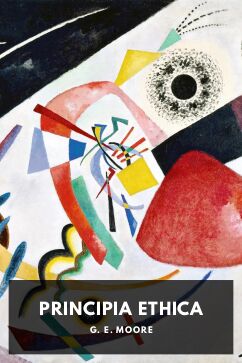
Principia Ethica - G. E. Moore
Read "Principia Ethica - G. E. Moore" Online
This book is available in the public domain. Start reading the digital edition below.
Book Preview
A short preview of the book’s content is shown below to give you an idea of its style and themes.
Published in 1903, Principia Ethica isn't a story with characters and a plot. It's more like a philosophical blueprint. G.E. Moore, a young Cambridge philosopher, wanted to rebuild ethics from the ground up. He starts by clearing the rubble of old ideas he thinks are flawed.
The Story
Moore's main argument has two big parts. First, he introduces the Naturalistic Fallacy. This is his claim that it's a logical error to define 'good' (a non-natural property) by pointing to any natural property, like 'pleasure' or 'what is desired.' To him, 'good' is simple and indefinable. You can't break it down into smaller parts. Trying to define it is like trying to define the color yellow to a blind person—it's a direct experience of understanding.
The second part asks: if we can't define good, what is good? Moore's famous answer is that the most valuable things in life are certain states of consciousness. He points to the appreciation of beauty and the pleasures of human affection as prime examples of intrinsic goods. The rest of the book is him applying this idea, arguing about what we can know about good and how we should act to bring more of it into the world.
Why You Should Read It
I'll be honest, some parts are tough. Moore's writing is precise, and he builds his case like a mathematician. But the core idea is electrifying. Reading it, you feel like you're watching someone solve a puzzle everyone else was struggling with. His critique of reducing ethics to science or simple feelings still hits home today. Whenever someone says 'good just means what helps us evolve,' or 'it's just whatever makes you happy,' Moore is the ghost in the room saying, 'Are you sure? Prove it.'
More than just criticism, he offers a positive, if challenging, vision. By pointing to beauty and friendship as fundamental goods, he grounds ethics in experiences that feel real and important, not just abstract rules. It makes you look at the best moments of your own life and wonder if he wasn't onto something.
Final Verdict
This is not a casual beach read. It's for the curious thinker who enjoys a serious mental workout. Perfect for students of philosophy, of course, but also for anyone who has ever argued about morals, politics, or values and felt like the conversation was going in circles. If you've read popular philosophy or ethics books and want to see where a lot of modern debates really started, this is a foundational text. Give yourself time, maybe a chapter at a sitting, and be ready to have your assumptions challenged on every page. It's a short book that casts a very long shadow.
This content is free to share and distribute. It serves as a testament to our shared literary heritage.
Michael Rodriguez
1 year agoAs someone who reads a lot, the author's voice is distinct and makes complex topics easy to digest. A valuable addition to my collection.







Charles Thompson
4 weeks agoA must-have for anyone studying this subject.