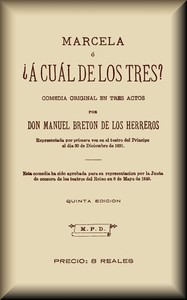
Marcela, o ¿a cuál de los tres? : Comedia original en tres actos

(14 User reviews)   6317
By John White Posted on Dec 22, 2025
In Category - Flight Science
Bretón de los Herreros, Manuel, 1796-1873 Bretón de los Herreros, Manuel, 1796-1873
Spanish
Ever been stuck between two bad choices? Try three! Picture this: a young woman, Marcela, finds herself engaged to not one, not two, but three different men—and they're all about to show up at her house at the same time. This 19th-century Spanish comedy is a masterclass in chaos. Forget slow burns; this play starts with a powder keg of a secret and lights the fuse in the first act. It’s all frantic whispers, slammed doors, and pure, hilarious panic as Marcela and her maid try to stop her world from exploding. If you love stories where the characters are in way over their heads and the only way out is through a whirlwind of lies and quick thinking, you’ll devour this in one sitting. It’s farce at its finest and funniest.
Share

Read "Marcela, o ¿a cuál de los tres? : Comedia original en tres actos" Online

This book is available in the public domain. Start reading the digital edition below.

START READING FULL BOOK
Instant Access    Mobile Friendly

Book Preview

A short preview of the book’s content is shown below to give you an idea of its style and themes.

(_Se pasea. Don Agapito, aburrido, se pone a trabajar en su cordón_). MARCELA. ¡Que siempre ha de estar de broma este don Martín! AGAPITO. (_A don Amadeo_). Amigo, poco favorable sopla el viento para nosotros. Don Martín es quien la logra. Mire usted qué amartelado, qué ufano está... No me importa. Yo sé bien que si Marcela de algún galán se enamora, será de mí, porque al cabo y al fin, aunque no me toca alabarme... ¡Ah, qué ocurrencia! ¿Por qué no hace usté unas coplas satíricas contra ese hombre que tanto nos encocora? AMADEO. No estoy para coplas. AGAPITO. Pero... AMADEO. Ni jamás contra personas determinadas... AGAPITO. No le hace. La venganza es muy sabrosa. Pero ya se ve, no siempre las deidades de Helicona... ¿Y que tiene usté entre manos ahora? AMADEO. Nada. (¡Qué mosca es el hombre!) AGAPITO. ¿Algún soneto a los desdenes de Flora? ¿Algún agudo epigrama? ¿O bien algunas estrofas? AMADEO. ¡Hombre!... AGAPITO. ¿O quizá algún poema al céfiro y a la aurora? AMADEO. No pienso... AGAPITO. ¿Alguna elegía? ¿Alguna oda? ¡Oh!, las odas... AMADEO. No señor. Voy a escribir, no con tinta, con ponzoña, una sátira sangrienta contra hombrecillos de alcorza, que solo tienen talento para bailar la gavota; que por un yerro de imprenta son hombres y no son monas; que huelen a majaderos al través de tanto aroma; que si España fuera Egipto, pudieran pasar por momias; que con su voz de falsete los oídos me destrozan; que con su extraña figura siempre a risa me provocan; que con sus gestos me pudren, me empalagan con sus modas... y en fin, con necias preguntas, me fastidian, me sofocan. AGAPITO. Ya; pero eso ha de entenderse con quien... MARCELA. Doblemos la hoja, don Martín, y guarde usted para quien no le conozca esas frases de cartilla. MARTÍN. ¿Y por qué ha de ser lisonja, y no...? MARCELA. ¡Por Dios, don Martín! Mire usted que no soy tonta. MARTÍN. (Otra será su respuesta cuando me declare en forma.) MARCELA. Amigo don Amadeo, ¿teme usted que se le coman? ¿Cómo así, tan retirado? AMADEO. Quien de prudente blasona, señorita, se retira si conoce que incomoda. MARCELA. ¡A mí incomodarme usted! Con decirlo me sonroja. Don Martín me estaba hablando; y como siempre es chistosa su conversación... MARTÍN. (Yo venzo.) MARCELA. Me hacen gracia hasta las bolas que suele ensartar. MARTÍN. ¡Marcela! MARCELA. Yo le oigo como una boba. Ni era cosa de dejarle con la palabra en la boca. AGAPITO. ¡Sí; fácil es! MARCELA. Yo no gusto de insípidas ceremonias, y trato con confianza a mis amigos. Ahora soy de usted. AMADEO. (¡Oh dulces ojos! ¡Oh voz que el alma me roba!) Marcelita... MARCELA. ¿Piensa usted publicar alguna obra de su ingenio? MARTÍN. Mal hará, si no es alguna espantosa novela donde haya espectros, y violencias y mazmorras, y almas en pena, y suicidios... y en fin, eso que está en boga. Sobre todo, gran cartel, con cada letra tan gorda, y te haces hombre. Si aspiras a merecer la corona de escritor clásico, puro; si cuidas más de la gloria que del dinero, ¡ay de ti!, ningún cristiano te compra. AMADEO. No me desvela el afán de verme impreso. Es tan poca la confianza que tengo en mis versos... MARCELA. Es muy propia del verdadero saber la modestia. AMADEO. Usted me honra. (¡Oh bella!) MARCELA. Mas yo, que soy su amiga y admiradora, y por usted me intereso tanto... AMADEO. (¡Bien haya tu boca!) MARCELA. Siento que versos tan lindos, y que justamente elogian sujetos de ciencia y gusto, el público desconozca, cuando hace...

This is a limited preview. Download the book to read the full content.

Let's set the scene: Spain in the 1800s. Marcela, a clever young woman, is in a real bind. Through a series of... let's call them 'misunderstandings'... she has managed to become engaged to three different men: the wealthy Don Pedro, the dashing Don Juan, and the persistent Don Luis. The problem? They all think they're the only one. The bigger problem? All three are on their way to her home. Cue the panic!

The Story

The entire play unfolds in Marcela's parlor, which becomes a stage for a brilliantly orchestrated disaster. With the help of her quick-witted maid, Marcela tries to juggle her suitors, hiding one in a room as another arrives at the door. It's a non-stop game of romantic musical chairs fueled by mistaken identities, eavesdropping, and sheer desperation. You can almost hear the doors slamming and see the nervous glances. The question isn't just who she will choose, but how on earth she'll get out of this mess without ruining her reputation forever.

Why You Should Read It

Don't let the 19th-century setting fool you—this play feels incredibly fresh. The humor isn't dusty; it's rooted in the universal panic of being caught in a lie. Marcela is no passive heroine; she's actively trying to solve her own colossal problem, and her ingenuity is fun to watch. Bretón de los Herreros has a sharp eye for social satire, poking fun at vanity, greed, and the rigid courtship rules of his time. You're not just reading a comedy; you're getting a sly, witty look at how people navigate the expectations placed on them.

Final Verdict

This is a perfect pick for anyone who loves classic comedies like Shakespeare's mix-ups or Oscar Wilde's sharp wit, but wants to try something new from the Spanish stage. It's also great for readers who think older plays might be boring—this one proves they can be faster and funnier than most modern sitcoms. If you need a book that's pure, clever entertainment and can be read in an afternoon, look no further. Just be prepared to laugh at the glorious chaos.


⚖️ Community Domain

This content is free to share and distribute. Feel free to use it for personal or commercial purposes.

Dorothy Hernandez
1 year ago

Very interesting perspective.

Betty Wright
2 years ago

Without a doubt, the flow of the text seems very fluid. A true masterpiece.

Edward Flores
1 year ago

Five stars!

Deborah Williams
2 years ago

Having read this twice, the plot twists are genuinely surprising. A true masterpiece.
5
5 out of 5 (14 User reviews )

Add a Review

Your Rating *
There are no comments for this eBook.
You must log in to post a comment.
Log in


Related eBooks