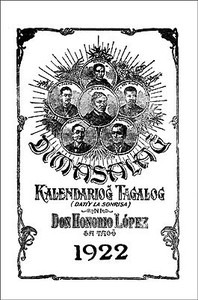
Dimasalang Kalendariong Tagalog (1922) by Honorio López

(5 User reviews)   3912
By John White Posted on Dec 22, 2025
In Category - Pilot Stories
López, Honorio, 1875-1958 López, Honorio, 1875-1958
Tagalog
Hey, have you ever wondered what your great-grandparents were actually thinking about day-to-day? I just found this amazing time capsule. It's not a novel; it's a calendar from 1922, but it's packed with way more than just dates. The author, Honorio López, used it to secretly teach Filipinos about their own history, language, and rights right under American rule. It's like a quiet act of rebellion disguised as a household item. The real story isn't in one plot, but in the hundreds of little entries that show how a culture kept its soul alive. It completely changed how I look at everyday objects.
Share

Read "Dimasalang Kalendariong Tagalog (1922) by Honorio López" Online

This book is available in the public domain. Start reading the digital edition below.

START READING FULL BOOK
Instant Access    Mobile Friendly

Book Preview

A short preview of the book’s content is shown below to give you an idea of its style and themes.

Ang AKLAT NG KABUHAYAN ay pihong lalabas na hanggang Marzo n~g 1922. Anim na piso ang halaga. Ang aklat na ito ang dapat na basahin n~g lahat, pagka't ito ang aklat n~g kaligtasan n~g tao sa lahat n~g kapahamakan at kamatayan. Natitipon dito ang m~ga arte ó paraan n~g panggagamot nila Tisot, Sta. Maria, Kusiko, Tavera, Delgado (hesuita), nila Dr. Villefond, Carvajal at iba pa. Hindi lumabas n~g nakaraang taon pagka't pinakaaayos ang yari. =DIMASALANG= =KALENDARYONG TAGALOG= NG Kgg. Honorio Lopez nag-konsehal, sa siyudad ng maynila _Licenciado sa Leyes. Bachiller sa Artes. Agrónomo. Agrimensor_ na may titulo n~g Gubierno. Publicista. _Tent. Coronel_ sa Hukbong Pilipino n~g nagdaang Himagsikan. Kasapi sa _Los Veteranos de la Revulucion,_ Naging _Asesor-Tecnico_ sa Union Agraria de Filipinas, Kasaping Pandan~gal sa Kapisanang Conciencia Libre sa Madrid, España =SA TAONG= =1922= NAGSIMULA NG TAONG 1898 IKA 24 TAONG PAGKAKAHAYAG Dapat Tandaan:--Gulang ng taon, 27. Epakta, 22. Katitikan Linggo, A. at Kabilan~gang Gintô, 4. * * * * * =Alin ang gulang ng babae na dapat sabihing matanda na?= Kung may magsasabi na ang gulang na kahilihili sa isáng babae, ay ang gulang na tatlong pu't limang taon, n~guni't hindî rin nawawalan n~g ibang nagsasabi na kapag ang babae'y sumapit sa tatlong pung taong gulang, ay matandâ na. Marahil nagkakaagawan ang dalawang kuròkurò sa dami n~g magkasangayon; n~guni't dapat unawain na ang dami n~g babaeng hinan~gaan sa gandá sa kasaysayan n~g Sangsinukuban n~g Pagibig at pagmamagarâ, ay sa gulang na tatlong pu't limang taon. Si Ninon de Lenclos nagkaroon n~g maraming man~gin~gibig n~g siya'y may anim na pung taon at sa gulang na siyam na pung taon ay may _pumapalike_ pa. Si Cleopatra sa gulang na tatlong pu't walo niya, n~g aglahiin sa pagibig ang m~ga hari. Si emperatris Josefina na bumihag sa pusô ni Napoleon I, ay matandâ kay sa gulang nito, n~g siya'y mapakasal na ang lahat ay nagsasabi na siya'y lalong bata sa emperador sa pagmumukhâ. Ang balitang nobelistang si J. Sand, ay lalong kaaakit n~g makaraan sa tatlong pung taon at sa gulang na lalong naulol sa kanya sa pagibig si Chopin. Si Elena de Troya nagkaroon n~g pû pûng man~gin~gibig n~g may apat na pung taon na, at si Adelina Patti nagkaroon n~g maraming manglilingkod sa kanyang kariktan hangga n~g mamatay. Sa n~gayon, kagalanggalang na dalagang kagulan~gan, bakit ka paghihinagpis sa iyong pagtandâ? Huag mong ipanglungkot ang pagiiwan sa iyo n~g kasariwaan n~g kabataan, pagka't kailan ma't magilas kayo at sinusunod ninyo ang m~ga aral sa pagpapaganda at pagpapakikinis n~g balat na itinuturô ng _Aklat n~g Kabuhayan_ ni Honorio Lopez, ay hindî kayo mawawalan n~g m~ga kandidato na laging aawit sa inyo n~g kirileson n~g Dios n~g Pagibig. * * * * * =PARAAN NG PAGGINHAWA= M~GA MAHALAGANG ARAL NG PILOSOPONG HAPONES NA SI MR. TUSE-KARI Marami n~g kahatulan ang naiturô n~g m~ga pantas at m~ga may pinagdaanan sa pamumuhay ukol sa paraan n~g pagginhawa. Naririyan ang m~ga mararalitang nagsiyaman na n~gayo'y itinatanghal n~g magandang kapalaran sa kaaya-ayang pamumuhay; nariyan din naman ang iba't ibang marurunong sa Europa at Amerika at ang m~ga pantas sa Indiya na nagturô at han~ggang n~gayo'y nagtuturo n~g m~ga kaparaanan n~g pagginhawa. N~guni't sa n~gayo'y isa namang paham na hapon, na tumutugon sa n~galang Tuse-kari, ay siyang naglathala n~g isang kaparaanan ó nagpapatibay n~g karunun~gan napuputi sa kalihiman n~g pagiisip, upang magamit ito sa bawa't ibigin ukol sa gawang mabuti, lalô na sa ikagiginhawa. Ang "Pagiisip" san~gayon kay Tuse-Kari, ay makakamtan ang lahat n~g bawa't ibigin n~g tao na matatamo niya, sa kabuhayan sukat na gamitin lamang ang pagiisip sa boong lakas na ankin. Ang sabi niya'y ganito:...

This is a limited preview. Download the book to read the full content.

Let's clear something up first: this isn't a storybook with a single plot. Dimasalang Kalendariong Tagalog is exactly what it says—a calendar published in 1922. But calling it just a calendar is like calling a Swiss Army knife just a blade. Each page, each month, is loaded with historical notes, biographies of Filipino heroes, proverbs, advice on farming and health, and lessons on the Tagalog language.

The Story

There's no main character or three-act structure here. The 'story' is the quiet, persistent project of Honorio López. While the Philippines was under American administration, he created this almanac to serve a dual purpose. On the surface, it helped families plan their year. Underneath, it was a tool for national identity. He filled it with knowledge that was being sidelined, ensuring that readers remembered their own history, celebrated their own language, and understood practical sciences from a Filipino perspective. The conflict is subtle but powerful: it's the gentle resistance of remembering in a time when forgetting might have been easier.

Why You Should Read It

Reading this feels like having a direct conversation with the past. You get a sense of what mattered to ordinary people a century ago—the crops they planted, the heroes they revered, the wisdom they lived by. López doesn't shout; he educates. His voice is that of a dedicated teacher who believed that real independence starts with knowing who you are. It's surprisingly moving to see how much care was put into a simple calendar, turning it into a manual for cultural survival.

Final Verdict

This is a unique treasure. It's perfect for history buffs who want to move beyond dates and battles to feel the texture of daily life, for Filipinos curious about their roots, or for anyone fascinated by how people use everyday objects to make a stand. Don't expect a thrilling narrative. Instead, expect to be humbled and intrigued by the quiet power of a book that was meant to be used, year after year, as a steady reminder of a people's spirit.


⚖️ Copyright Status

The copyright for this book has expired, making it public property. Distribute this work to help spread literacy.

Emma Wilson
11 months ago

Used this for my thesis, incredibly useful.

Deborah Walker
2 years ago

To be perfectly clear, it challenges the reader's perspective in an intellectual way. Highly recommended.

Dorothy Walker
1 year ago

Just what I was looking for.

Sandra Wilson
1 year ago

Comprehensive and well-researched.

Linda Lopez
2 years ago

After finishing this book, it provides a comprehensive overview perfect for everyone. Definitely a 5-star read.


4
4 out of 5 (5 User reviews )

Add a Review

Your Rating *
There are no comments for this eBook.
You must log in to post a comment.
Log in


Related eBooks