A Dictionary of Slang, Cant, and Vulgar Words by John Camden Hotten

(14 User reviews)   5195
By John White Posted on Jan 3, 2026
In Category - Flight Science
Hotten, John Camden, 1832-1873 Hotten, John Camden, 1832-1873
English
Hey, have you ever wondered what people in the 1800s *really* said when they thought no one respectable was listening? This isn't your grandma's dictionary. It's a secret history of Victorian England, told through the forbidden words they tried to scrub from the record. John Camden Hotten, a publisher with a nose for trouble, went underground to collect the slang of thieves, street vendors, and everyday folks. It's a wild, sometimes shocking, tour of a society's hidden language. Reading it feels like finding a trapdoor in a very proper drawing room floor.
Share

Read "A Dictionary of Slang, Cant, and Vulgar Words by John Camden Hotten" Online

This book is available in the public domain. Start reading the digital edition below.

START READING FULL BOOK
Instant Access    Mobile Friendly

Book Preview

A short preview of the book’s content is shown below to give you an idea of its style and themes.

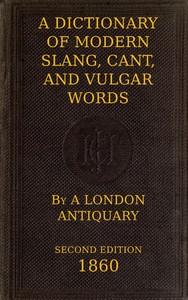
◇ _BONE_ (good). Safe for a “cold tatur,” if for nothing else. “_Cheese your patter_” (don’t talk much) here. ▽ _COOPER’D_ (spoilt), by too many tramps calling there. □ _GAMMY_ (unfavourable), likely to have you taken up. Mind the dog. ☉ _FLUMMUXED_ (dangerous), sure of a month in “_quod_” (prison). ⊕ _RELIGIOUS_, but tidy on the whole. _See page 37._ A DICTIONARY OF MODERN SLANG, CANT, AND VULGAR WORDS, USED AT THE PRESENT DAY IN THE STREETS OF LONDON; THE UNIVERSITIES OF OXFORD AND CAMBRIDGE; THE HOUSES OF PARLIAMENT; THE DENS OF ST. GILES; AND THE PALACES OF ST. JAMES. PRECEDED BY A HISTORY OF CANT AND VULGAR LANGUAGE; WITH GLOSSARIES OF TWO SECRET LANGUAGES, SPOKEN BY THE WANDERING TRIBES OF LONDON, THE COSTERMONGERS, AND THE PATTERERS. By A LONDON ANTIQUARY. “Rabble-charming words, which carry so much wild-fire wrapt up in them.”—SOUTH. SECOND EDITION, REVISED, WITH TWO THOUSAND ADDITIONAL WORDS. LONDON: JOHN CAMDEN HOTTEN, PICCADILLY. 1860. LONDON: PRINTED BY TAYLOR AND GREENING, GRAYSTOKE-PLACE, FETTER-LANE, E.C. PREFACE TO THE SECOND EDITION. The First Edition of this work had a rapid sale, and within a few weeks after it was published the entire issue passed from the publisher’s shelves into the hands of the public. A Second Edition, although urgently called for, was not immediately attempted. The First had been found incomplete and faulty in many respects, and the author determined to thoroughly revise and recast before again going to press. The present edition, therefore, will be found much more complete than the First; indeed, I may say that it has been entirely rewritten, and that, whereas the First contained but 3,000 words, this gives nearly 5,000, with a mass of fresh illustrations, and extended articles on the more important slang terms—HUMBUG, for instance. The notices of a _Lingua Franca_ element in the language of London vagabonds is peculiar to this edition. My best thanks are due to several correspondents for valuable hints and suggestions as to the probable etymologies of various colloquial expressions. One literary journal of high repute recommended a division of cant from slang; but the annoyance of two indices in a small work appeared to me to more than counterbalance the benefit of a stricter philological classification, so I have for the present adhered to the old arrangement; indeed, to separate cant from slang would be almost impossible. Respecting the HIEROGLYPHICS OF VAGABONDS, I have been unable to obtain further information; but the following extract from a popular manual which I have just met with is worth recording, although, perhaps, somewhat out of place in a Preface. “Gipseys follow their brethren by numerous marks, such as strewing handfuls of grass in the day time at a four lane or cross roads; the grass being strewn down the road the gang have taken; also, by a cross being made on the ground with a stick or knife, the longest end of the cross denotes the route taken. In the night time a cleft stick is placed in the fence at the cross roads, with an arm pointing down the road their comrades have taken. The marks are always placed on the left-hand side, so that the stragglers can easily and readily find them.”—_Snowden’s Magistrate’s Assistant_, 1852, p. 444. _Piccadilly, March 15th, 1860._ PREFACE TO THE FIRST EDITION. If any gentleman of a studious turn of mind, who may have acquired the habit of carrying pencils and notebooks, would for one year reside in Monmouth Court, Seven Dials; six months in Orchard Street, Westminster; three months in Mint Street, Borough; and consent to undergo another three months on the extremely...

This is a limited preview. Download the book to read the full content.

Forget dry lists of definitions. A Dictionary of Slang, Cant, and Vulgar Words is more like a time capsule from the gritty streets of 19th-century London. The author, John Camden Hotten, wasn't a stuffy academic. He was a publisher who loved the raw, vibrant language of the people. His 'plot' is simple: he ventures into markets, docks, and pubs to listen and record. The book is his collection of what he found—the secret codes of pickpockets, the playful insults of costermongers, and the blunt words polite society pretended didn't exist.

Why You Should Read It

This book completely changed how I see history. Textbooks give you dates and laws; Hotten gives you the voices. You learn that Victorians had a hilarious slang for being drunk ('screwed,' 'lushy,' 'half-seas-over') and creative terms for everything from a bad meal to a police officer. It's funny, surprising, and often eye-opening. It shows that people back then were just as clever, crude, and human as we are today. Reading it feels like getting the inside scoop from a chatty time traveler.

Final Verdict

Perfect for anyone who loves language, history, or a good bit of social gossip from the past. If you're a writer looking for authentic period flavor, a curious mind tired of polished history, or just someone who enjoys the weird evolution of words, you'll find this absolutely fascinating. It's not a cover-to-cover read, but a book to dip into. You'll never watch a period drama the same way again.


⚖️ Community Domain

This content is free to share and distribute. Knowledge should be free and accessible.

Carol Miller
4 months ago

Essential reading for students of this field.

Donald Smith
1 year ago

If you enjoy this genre, it challenges the reader's perspective in an intellectual way. A true masterpiece.

Melissa Walker
1 year ago

Surprisingly enough, the author's voice is distinct and makes complex topics easy to digest. Truly inspiring.

Matthew Lewis
2 years ago

I came across this while browsing and it challenges the reader's perspective in an intellectual way. I will read more from this author.

Patricia Moore
1 year ago

Having read this twice, the narrative structure is incredibly compelling. I would gladly recommend this title.

5
5 out of 5 (14 User reviews )

Add a Review

Your Rating *
There are no comments for this eBook.
You must log in to post a comment.
Log in


Related eBooks