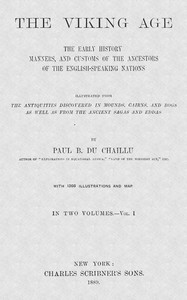
The Viking Age. Volume 1 (of 2) by Paul B. Du Chaillu

(5 User reviews)   2343
By John White Posted on Jan 13, 2026
In Category - Aircraft History
Du Chaillu, Paul B. (Paul Belloni), 1835-1903 Du Chaillu, Paul B. (Paul Belloni), 1835-1903
English
Okay, I just finished this book and I have to tell you about it. Forget everything you think you know about Vikings from TV shows. This isn't about horned helmets and mindless raids. Paul B. Du Chaillu's 'The Viking Age' is a wild ride that asks a huge question: what if the people we call Vikings weren't just Scandinavian pirates, but a massive, interconnected civilization that stretched across Europe and even into Africa? He's not just retelling sagas; he's piecing together clues from language, archaeology, and old records to argue that these 'Northmen' had settlements and influence everywhere, from the coasts of France to the rivers of Russia, long before history books usually say. The book's central mystery is this grand, almost detective-like search for their true origins and reach. It feels less like dry history and more like watching someone solve a giant, ancient puzzle. It's fascinating, a bit controversial, and completely changes the game on who these people really were.
Share

Read "The Viking Age. Volume 1 (of 2) by Paul B. Du Chaillu" Online

This book is available in the public domain. Start reading the digital edition below.

START READING FULL BOOK
Instant Access    Mobile Friendly

Book Preview

A short preview of the book’s content is shown below to give you an idea of its style and themes.

the love of conquest being the most prominent traits of their character. The mighty sword with all its evils has thus far always proved a great engine of civilisation. To get a satisfactory answer to the above questions we must go far back, and study the history of the race who settled in Britain during and after the Roman occupation. We shall thus find why their descendants are to-day so brave, successful, energetic and prosperous in the lands which they have colonised; and why they are so pre-eminently skilled in the art of self-government. We find that a long stretch of coast is not sufficient, though necessary, to make the population of a country a seafaring nation. When the Romans invaded Britain, the Brits had no fleet to oppose them. We do not until a later period meet with that love of the sea which is so characteristically English:—not before the gradual absorption of the earlier inhabitants by a blue-eyed and yellow-haired seafaring people who succeeded in planting themselves and their language in the country. To the numerous warlike and ocean-loving tribes of the North, the ancestors of the English-speaking people, we must look for the transformation that took place in Britain. In their descendants we recognise to this day many of the very same traits of character which these old Northmen possessed, as will be seen on the perusal of this work. Britain, after a continuous immigration which lasted several hundred years, became the most powerful colony of the Northern tribes, several of the chiefs of the latter claiming to own a great part of England in the seventh and eighth centuries. At last the time came when the land of the emigrants waxed more powerful, more populous than the mother-country, and asserted her independence; and to-day the people of England, as they look over the broad Atlantic, may discern a similar process which is taking place in the New World. The impartial mind which rises above the prejudice of nationality must acknowledge that no country will leave a more glorious impress upon the history of the world than England. Her work cannot be undone; should she to-day sink beneath the seas which bathe her shores, her record will for ever stand brilliantly illuminated on the page of history. The great states which she has founded, which have inherited her tongue, and which are destined to play a most important part in the future of civilisation, will be witnesses of the mighty work she has accomplished. They will look back with pride to the progenitors of their race who lived in the glorious and never-to-be-forgotten countries of the North, the birthplace of a new epoch in the history of mankind. As ages roll on, England, the mother of nations, cannot escape the fate that awaits all; for on the scroll of time this everlasting truth is written—birth, growth, maturity, decay;—and how difficult for us to realise the fact when in the fulness of power, strength, and pride! Where is or where has been the nation that can or could exclaim, “This saying does not apply to me; I was born great from the beginning; I am so now, and will continue to be powerful to the end of time.” The ruined and deserted cities; the scanty records of history, which tell us of dead civilisations, the fragmentary traditions of religious beliefs, the wrecks of empires, and the forgotten graves, are the pathetic and silent witnesses of the great past, and a sad suggestion of the inevitable fate in store for all. The materials used in these volumes, in describing...

This is a limited preview. Download the book to read the full content.

Paul B. Du Chaillu's The Viking Age, Volume 1 isn't your standard chronological history. Instead, think of it as a grand investigation. Du Chaillu, an explorer and writer, acts like a detective sifting through evidence. He uses everything from the similarities between old European languages to ancient burial sites and fragmented chronicles. His goal is to build a case for the Vikings not as occasional invaders, but as a foundational cultural force across the continent.

The Story

The book doesn't follow a single narrative or king. Instead, it builds an argument chapter by chapter. Du Chaillu starts by looking at the Norse myths and legends, treating them as distorted memories of real history and migration. Then, he compares words, customs, and artifacts from different parts of Europe, trying to trace them all back to a common, Northern source. He talks about ship burials in England, weapon designs in Frankia, and place names in Normandy, insisting these aren't just leftovers from raids, but proof of widespread settlement and cultural blending. The 'plot' is the slow, meticulous revelation of this hidden network of Viking influence that he believes has been overlooked.

Why You Should Read It

What makes this book so engaging is Du Chaillu's obvious passion. You can feel his excitement when he connects two pieces of evidence. It's like being shown a secret map of Europe. Sure, some of his 19th-century theories have been debated or superseded by modern archaeology—and that's part of the fun! Reading this is a conversation across time. You get a brilliant, sweeping vision of the past, but you're also reminded how our understanding of history evolves. The characters here aren't just Ragnar or Leif Erikson, but the cultures themselves, portrayed as living, moving, and clashing entities.

Final Verdict

This book is perfect for history buffs who are tired of the same old stories and want to see how historical ideas are built from the ground up. It's also great for anyone who loves a good intellectual mystery. Be warned: it's dense and detailed, not a breezy novel. But if you're willing to dive in, you'll be rewarded with a perspective on the Viking Age that is incredibly bold and thought-provoking, even 150 years later. It’s less of a definitive textbook and more of a fascinating, passionate starting point for your own curiosity.


🔓 Community Domain

This masterpiece is free from copyright limitations. Distribute this work to help spread literacy.

David Moore
1 year ago

Not bad at all.

John Torres
1 year ago

Based on the summary, I decided to read it and the depth of research presented here is truly commendable. Exceeded all my expectations.

Paul Johnson
4 weeks ago

Text is crisp, making it easy to focus.

Christopher King
1 year ago

Very interesting perspective.

Matthew Perez
9 months ago

As someone who reads a lot, it provides a comprehensive overview perfect for everyone. Thanks for sharing this review.

5
5 out of 5 (5 User reviews )

Add a Review

Your Rating *
There are no comments for this eBook.
You must log in to post a comment.
Log in


Related eBooks