
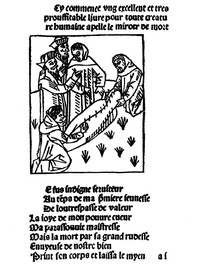
Le miroir de mort by Georges Chastellain
Read "Le miroir de mort by Georges Chastellain" Online
This book is available in the public domain. Start reading the digital edition below.
START READING FULL BOOKBook Preview
A short preview of the book’s content is shown below to give you an idea of its style and themes.
Before we dive in, a quick heads-up: 'Le Miroir de Mort' isn't a novel. Don't go in expecting a plot with knights and dragons. Think of it more as a very long, very intense meditation. Georges Chastellain was a chronicler and poet for the Dukes of Burgundy, so he had a front-row seat to the political dramas and bloody battles of the 1400s.
The Story
There isn't a traditional narrative. Instead, Chastellain builds his case like a lawyer arguing before the court of eternity. He piles up example after example of human folly. He points to the mighty princes and wealthy merchants, showing how their plans and pride are made meaningless by death. He describes the physical decay of the body in unflinching detail. The 'mirror' he holds up is meant to reflect not our faces, but our mortality. The whole work is a powerful reminder that death is the great leveler, stripping away titles, wealth, and power. It's a sermon, a warning, and a philosophical puzzle all in one.
Why You Should Read It
I'll be honest, it's not a breezy read. The language is dense and the themes are heavy. But that's also why it's so gripping. You're getting the uncensored thoughts of a smart, sensitive man living through constant uncertainty. When he writes about the instability of life and the vanity of worldly pursuits, it doesn't feel like abstract philosophy—it feels lived. He saw these truths play out in real time. Reading it, you start to see the medieval mindset not as superstitious and simple, but as deeply preoccupied with the biggest questions. It adds a rich, somber layer to how we view the so-called 'Age of Chivalry.' The beauty is in the brutal clarity.
Final Verdict
This book is a specialist's treasure, but curious general readers can find something here too. It's perfect for history buffs who want to go beyond dates and battles into the medieval psyche. It's also for anyone who loves classic memento mori art (those paintings with skulls and wilting flowers)—this is that, in literary form. If you enjoy thoughtful, challenging texts that sit with you long after you finish, give it a try. Just be prepared to look in the mirror he's holding up.
This title is part of the public domain archive. You are welcome to share this with anyone.
David Davis
1 year agoThis is one of those stories where the flow of the text seems very fluid. Highly recommended.
Brian Jackson
1 year agoBased on the summary, I decided to read it and the author's voice is distinct and makes complex topics easy to digest. I will read more from this author.
Deborah Clark
1 year agoAs someone who reads a lot, it manages to explain difficult concepts in plain English. Thanks for sharing this review.
Betty White
1 year agoPerfect.






George Lee
6 months agoSimply put, the flow of the text seems very fluid. One of the best books I've read this year.